
What is petite sizing? The short answer is that petite clothing is cut for women around 5’4″ and under. The longer answer explains why regular sizes never quite fit and why so many “petite” search results disappoint. Petite describes proportion. Height is only the starting point.
This post covers what changes in a petite pattern, how petite compares with short and regular, and how to tell a real petite item from one that just carries the label.
What the petite label really describes
A petite garment is built for a smaller frame with different proportions from the standard size chart. Height is the usual cutoff, and 5’4″ and under is the most common one. But there is no industry standard for petites. Every brand decides for itself who its petite line is for and how it’s cut, so a petite from one retailer can fit very differently from another’s, and some brands use the label loosely. That’s also why my picks include some short options alongside the petites. When I do, I call it out, so you always know which is which.
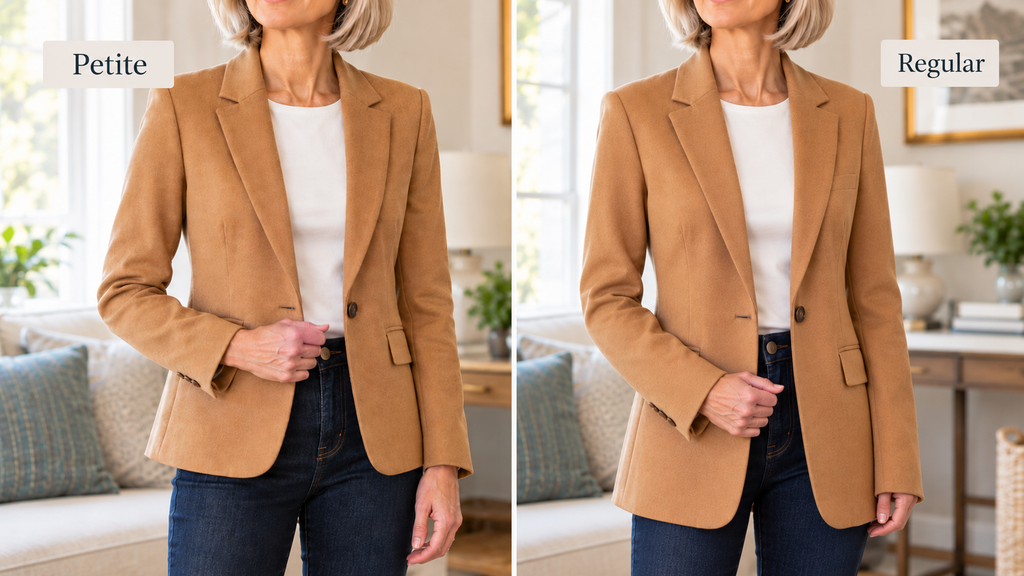
What the label really signals is that the pattern pieces were redrawn. The shoulders, sleeves, torso, rise and hem are all adjusted, not only the length at the bottom. A petite size 12 is not a regular 12 with a shorter hem. It’s a different shape in the same size number.
That also explains why height alone doesn’t settle which label suits you. Two women at 5’2″ can have different torso lengths and different shoulder widths, and one may do better in petite while the other prefers regular.
What’s different in a petite pattern
Here’s what typically changes when a pattern is re-proportioned:
- Shoulders: The shoulder seam sits closer to the neck, so it lands on your shoulder instead of drooping toward your arm.
- Sleeves: They’re shorter, and the elbow shaping moves up so the bend of the sleeve falls where your elbow actually is.
- Torso length: The body is shorter from shoulder to waist and to hem. Waistlines, bust darts and pocket placement move up with it, so they land where they were designed to.
- Rise: The distance from the crotch seam to the waistband is shorter, so pants and jeans sit at your waist instead of bunching or riding up.
- Hem and inseam: Lengths are shortened in proportion, and on pants the knee position is adjusted too.
Garments with a shaped feature, such as a blazer button, a cardigan pocket or a dress waist seam, show the difference most. The feature is only flattering if it sits at the right spot on your body.
What are petite pants, and how do they differ from hemmed regular pants?
Petite pants are the clearest example. A regular pair hemmed shorter fixes one measurement, the inseam. A true petite pair changes the rise, the thigh, the knee placement and the leg opening along with it.
If you’ve ever hemmed regular pants and still felt something was wrong, the problem is probably above the hem. The rise may be too long, so the waistband sits high on your ribs or the crotch hangs low. The knees may fall below where your own knees are, and the leg may taper in the wrong place.
I cover how to measure in The Petite Sizing Guide, linked below. The takeaway here is that petite pants and shortened regular pants are two different products.
Petite vS. Regular vS. Short: Which Sizing Fits You
The three labels describe different things, and brands don’t always use them the same way.
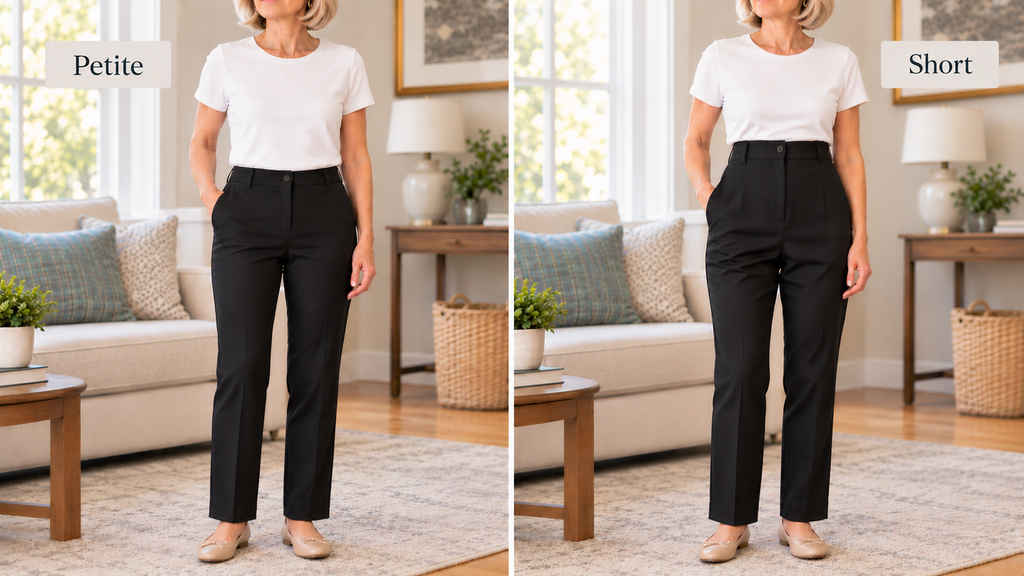
- Petite refers to a whole garment re-proportioned for a shorter frame.
- Short usually refers to length only. On pants it often means a shorter inseam in an otherwise regular cut. Some brands also use “short” as a height range, so check the brand’s size chart.
- Regular is the standard pattern, generally designed around women roughly 5’5″ to 5’7″.
To decide between petite clothing vs. regular clothing, look at where regular clothes go wrong. If the sleeves are too long, the shoulders slip, the waist hits the wrong place and the rise is too long, you likely need petite. If everything fits except the leg length, a “short” inseam or a hem might be enough. If a regular fits well apart from small adjustments, you may be a petite-friendly regular.
Over 40, bodies often change in the torso and midsection, which can shift what works. A petite cut that was perfect years ago may now fit differently through the waist or hip. That’s a fit issue and has nothing to do with your size being wrong. Keep your height, torso length and shoulder width in mind together, and don’t rely on one number.
Why “petite” search results are full of items that aren’t petite
If you search “petite” on a big retail site, you’ll often get items that aren’t petite at all. Search filters can match the word anywhere in a listing. A product might appear because it’s a “petite” print, because a size range includes an XS, or because a brand tagged everything loosely. Sometimes sites treat “short” or “XS” as petite when the cut is regular.
This is a big reason I research petite finds for you, and why my roundups list the sizes offered, the price and the key measurements instead of leaning on the label.
Signs that an item is a real petite:
- It’s listed in a distinct petite size range, such as PXS to PXL or petite 2 to 16, and not only in numbered sizes.
- It has its own measurements for petite sizes, such as a shorter inseam and sleeve length.
- The retailer has a separate petite department or filter that works.
- The product description says the garment is cut for a petite frame.
A garment with “petite” only in the product title, and the same measurements as the regular version, isn’t one.
What to check on a product page before you buy
Before you add anything to your cart, scan the page for these:
- Sizes offered. Are there petite sizes, and do they have their own size chart?
- Rise. For pants and jeans, look for the rise measurement. When it’s missing, check whether the description says high or mid-rise. In my jeans roundups I label each pair high or mid-rise because many retailers leave the number out. You can see how that looks in my petite jeans for fall roundup.
- Inseam. Compare it to your own inseam, including how you like your hems to fall with the shoes you’ll wear.
- Key measurements. Look for sleeve length, shoulder width and garment length on tops, jackets and dresses. Check them against a garment you already own that fits well.
- Model information. If the model’s height is listed, see how the garment falls on her relative to your own height.
- Reviews from petite shoppers. Search reviews for “petite” or for people who mention their height.
Measurements beat labels every time. If a page doesn’t give them, treat that as a reason to look elsewhere.
When petite doesn’t work for you and what to try instead
Sometimes petite sizing doesn’t fit, even when you’re short enough. Brand cuts differ, and your proportions may not match theirs. Here are a few options:
- Petite-friendly regular: Some regular items are cut shorter in the sleeve or body, or are styles that don’t depend on exact placement, like a drop-waist knit or an open cardigan. Look for these when the petite range is limited.
- Tailoring: Shortening sleeves, hems and straps is routine for a tailor, and it’s a good fix for a garment that fits everywhere else. Shoulders and rises cost more to alter, so choose items where the main adjustment is a hem. For more fit pitfalls to avoid, see 7 Petite Fashion Mistakes Women Over 40 Make.
- In-between sizes: If you fall between petite sizes, check the size chart measurements instead of guessing. Stretch fabrics are more forgiving, while woven pieces such as trousers and blazers are not.
- Another brand: A cut that doesn’t suit you says nothing about your body. Try a different brand’s petite line.
Knowing which label to use, and what to check before you buy, makes shopping faster and returns less frequent.
Ready to put this into practice? Take your own numbers with The Petite Sizing Guide, then browse the 10 Best Petite Pants For Women, where I’ve listed sizes, prices and the measurements that matter.
Save this post to your Pinterest board so it’s handy next time you shop.